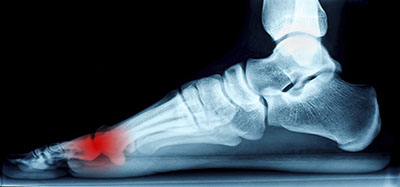
Morton’s neuroma may develop when the tissue around one of the nerves leading to your foot begins to thicken. When this occurs, you may experience some discomfort as if you were standing on a pebble stuck in your shoe. Most symptoms will not appear outwardly and will be experienced in the form of a sharp, burning pain in the ball of the foot, as well as a stinging or burning feeling in the toes that may sometimes lead to numbness.
Some factors that contribute to the formation of Morton’s neuroma include wearing high heels or ill-fitting shoes that put extra pressure on your toes or the balls of your feet. There has also been a tie to the development of Morton’s neuroma and certain high-impact sporting activities. Activities you may want to avoid from participating in too frequently include both jogging and running. Too much repetitive trauma can cause a strain on the feet and increase the chances of developing a foot complication. Other sports that require the use of tightly worn shoes, such as skiing or rock climbing, may also increase your chances of getting Morton’s neuroma. Certain foot deformities can also lead to the development of Morton’s neuroma. Some of these deformities that increase the likelihood of getting this condition include bunions, hammertoes, and flat feet.
Treatment for Morton’s Neuroma will often vary, depending on the severity of a patient’s condition. In some cases, injections may be helpful for alleviating pain. Another form of treatment is decompression surgery, in which a podiatrist will work to alleviate the pressure on the nerve. In more severe cases, full removal of the nerve would be required.
If you’d like more information about Morton’s neuroma, we suggest you consult with a podiatrist for a proper diagnosis and recommended treatment plan.
Neuroma Q & A
What is a neuroma?
A neuroma is thickened nerve tissue. Morton’s neuroma (also known as an intermetatarsal neuroma) is the most common one that affects the foot. It occurs between your third and fourth toes between the metatarsal bones. You can also get neuromas in other parts of your foot.
The tissue thickening and enlargement that causes a neuroma is due to compression and irritation of the nerve. Untreated neuromas can result in permanent nerve damage and chronic pain.
What symptoms does a neuroma cause?
A neuroma causes ongoing pain plus tingling or burning sensations and numbness in your forefoot. You might feel like there’s something inside the ball of your foot or that your sock is bunched up in your shoe.
Symptoms start gradually and may go away if you remove your shoe, massage the foot, or avoid footwear and activities that aggravate your symptoms. As the neuroma gets bigger, your symptoms become worse and the pain more constant.
What causes a neuroma?
The compression and irritation of your nerve that leads to neuromas could result from:
- Wearing shoes with a small or narrow toe box
- Wearing high-heeled shoes
- Bunions
- Hammertoes
- Flexible flatfoot
If you play sports or take part in activities that cause repeated irritation of the ball of your foot, that can also lead to a neuroma.
How is a neuroma treated?
To treat a mild to moderate neuroma, your podiatrist might recommend noninvasive approaches. These could include:
- Padding the metatarsal arch
- Applying an ice pack
- Wearing supportive shoes
- Nonsteroidal anti-inflammatory drugs (NSAIDs)
- Orthotic shoe inserts
- Physical therapy
- Soft-tissue massage and mobilization
- Stretching and strengthening exercises
- Ultrasound therapy
You should also limit your activities until the neuroma symptoms improve, and avoid going barefoot. Some patients might need corticosteroid or alcohol injections to help reduce the inflammation and nerve enlargement.
Would I need surgery for a neuroma?
You might benefit from surgery for your neuroma if conservative treatments and steroid injections don’t relieve your symptoms.
The Trinity Foot & Ankle Specialists team performs advanced, minimally invasive decompression surgery to treat neuromas. They’ve had specialized training in nerve release techniques that spare the nerve, reducing the risk that you’ll lose the feeling in your forefoot and toes.
The team can also perform nerve removal if necessary. They do both primary and revision neuroma surgery using specialized loupe magnification to visualize the nerve more clearly.
To find a solution to your painful neuroma, call Trinity Foot & Ankle Specialists today, or book an appointment online.
