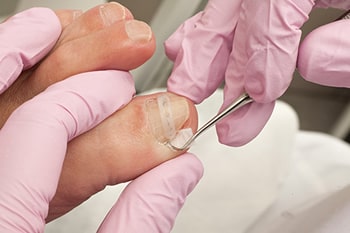
Ingrown toenails can form when the side of a toenail begins to grow into the flesh surrounding the nail. As a result, the affected toe—most commonly the big toe—may become red, swollen, painful, and—in severe cases—infected.
There are many reasons why an ingrown toenail may develop. Improperly cutting your toenails is a major cause of ingrown toenails. If toenails aren’t cut straight across or are cut too short, the likelihood of getting an ingrown toenail may increase. Other causes include having unusually curved toenails, wearing shoes that don’t give your toes an ample amount of space, and hereditary factors. Injuring the toe by stubbing it or having an object fall on it may also lead to ingrown toenails. If left untreated, an ingrown toenail can lead to further complications with the foot.
If you are someone who has diabetes, it’s extremely important to remain mindful of ingrown toenail prevention, as minor cuts or simple scrapes can lead to serious complications. You can prevent ingrown toenails by ensuring toenails are straight across and at a moderate length, wearing shoes that fit properly, and checking feet daily for signs of foot issues.
Treatment for an ingrown toenail will vary on a case by case basis. One form of treatment requires lifting the ingrown nail and placing a splint or piece of cotton underneath. Another method for a more severe case would involve partially removing the nail. For cases that need extreme care, the nail itself and tissue would have to be removed.
If you’d like more information about ingrown toenails, we recommend you consult with a podiatrist who can give you a proper diagnosis and go over your treatment options.
Ingrown Toenails Q & A
What are ingrown toenails?
Ingrown toenails (onychocryptosis) occur when the sides or corners of the toenail dig into your skin. Ingrown toenails generally affect your big toe, causing problems like:
- Pain
- Redness
- Swelling
- Tenderness
- Soreness
Left untreated, ingrown toenails can become infected. In addition, the skin may start to grow over your ingrown toenail. If you have a disorder that causes poor blood flow to your feet, such as diabetes or peripheral artery disease (PAD), you’re more at risk of getting complications with ingrown toenails.
What causes ingrown toenails?
Ingrown toenails usually develop if you trim your toenails too short, so the top of the nail is lower than the top of your toe. Cutting your toenails at the sides is particularly likely to cause ingrown toenails. This condition is almost always preventable if you cut your toenails correctly. Other risk factors for ingrown toenails include:
- Injury
- Fungal infection
- Heredity
- Poor foot structure
Pressure on your toe from shoes that are too small and wearing tight socks can also encourage the development of ingrown toenails.
What treatments are available for ingrown toenails?
In most cases, you can treat your ingrown toenails at home by soaking your foot in warm, soapy water. Do this several times each day and avoid wearing tight socks or shoes.
If you have badly ingrown toenails that are causing more severe pain or there are any signs of infection, visit Trinity Foot & Ankle Specialists. They may:
Lift the nail
A slightly ingrown toenail that’s causing redness and pain, but where there’s no pus, might respond to lifting. Your podiatrist carefully lifts the edge of the nail that’s growing into your skin and puts a splint, cotton, or dental floss under it. This separates your ingrown toenail from the skin and helps guide the nail, so it grows over your skin rather than into it.
Partially remove the nail
Removal of the ingrown segment of the nail might be necessary for a more severe ingrown toenail (where there’s redness, pain, and pus). Your podiatrist at Trinity Foot & Ankle Specialists numbs your toe with a local anesthetic before cutting out the ingrown portion.
Remove some of the nail bed
If you continually have problems with the same toe, your podiatrist might suggest removing a portion of the nail and the nail bed (the underlying tissue). They may use chemical or laser matrixectomy procedures to remove the part of your toe where a new nail grows.
If you have an ingrown toenail, get fast, effective treatment by calling Trinity Foot & Ankle Specialists today or using the online form to book an appointment.
