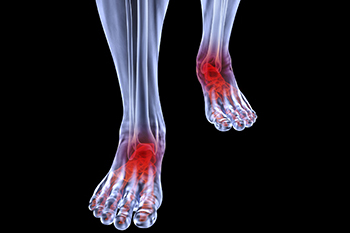
Conditions affecting the feet due to complications with arthritis can take many forms, including osteoarthritis, rheumatoid arthritis, gout, psoriatic arthritis, and ankylosing spondylitis. Osteoarthritis typically affects the joint connecting your big toe to your foot, though it can also be found in the midfoot or ankle region. Unlike osteoarthritis, rheumatoid arthritis typically affects both feet and deals with the same joints on each foot. Gout, which normally affects the big toe, is comprised of needle-like crystals that trigger inflammation in the joints. Psoriatic arthritis causes sausage-like swelling in the toes. Lastly, ankylosing spondylitis can lead to plantar fasciitis and pain at the Achilles tendon.
Many factors play a role in the cause for arthritic feet, including obesity, the aging process, as well as family history or genetic connections to arthritis.To help prevent issues with your feet, examine your feet daily, keep your feet clean, routinely moisturize your feet, keep your toenails trimmed, inspect your shoes for anything that may cause discomfort, and wear socks on a daily basis.
If you’re experiencing any discomfort or pain due to one of the above forms of arthritis, consider over-the-counter pain medication and investing in comfortable footwear. Pain medication coupled with top of the line comfort footwear is a great way to ease the pain that often comes with arthritis. If you’re overweight, it’s also recommended to think about setting a weight loss goal to ease some of the pressure on your feet, as well stay as active as possible. Applying ice or heat to the affected area is another way to calm the discomfort you may experience. It’s important to do research and see whether inserts may be beneficial for you. General foot care, like pampering your feet and keeping them well maintained, is also recommended. Lastly, you should seek professional advice and learn about potential surgery options, if necessary.
For an official diagnosis and information on treatment options, consult with a podiatrist.
Arthritis Q & A
What is arthritis?
Arthritis means inflammation of the joints, and there are many types of arthritis. Common types that affect the feet and ankles include:
Osteoarthritis (OA)
Osteoarthritis is the breakdown of cartilage in the joints. Cartilage is the connective tissue that cushions the bones that make up the joints, allowing for ease of movement. Cartilage loss hinders movement, causing pain, inflammation, and stiffness.
OA is the most common type of arthritis.
Gout
Gout is a metabolic form of arthritis that develops when there’s too much uric acid in the blood. Uric acid is a byproduct of purines, a natural substance made in your body and found in food.
The excess uric acid in your blood crystallizes and settles in the joints in the lower extremities, most often affecting the joint in the big toe.
Rheumatoid arthritis (RA)
RA is an autoimmune condition where your immune system attacks the joints, causing inflammation. RA may affect any joint, but it most often starts in the smaller joints like those in the feet or ankles.
Psoriatic arthritis
Psoriatic arthritis is a type of arthritis common in people with psoriasis. This condition causes joint inflammation and pain that may affect the joints in your feet or ankles.
What causes arthritis in the feet and ankles?
You may develop arthritis in the feet or ankles if you have an arthritis condition, such as RA, gout, or psoriatic arthritis. Osteoarthritis occurs from the general wear-and-tear of aging.
However, injuries or foot conditions may increase your risk of developing OA in your feet or ankles. For example, OA in the big toe may occur if you previously kicked or jammed the toe. A fracture in the midfoot is also a common cause of arthritis.
Having flat feet or high arches may also increase your risk of OA.
What are the treatments for arthritis?
Whatever the cause of your arthritis, the team at Trinity Foot & Ankle Specialists can provide care to ease your pain and improve your mobility. They offer conservative and surgical options.
Nonsurgical treatments include:
- Icing
- Nonsteroidal anti-inflammatory drugs (NSAIDs)
- Custom orthotics
- Bracing
- Physical therapy
- Stretching exercises
- Activity modification
- Injection therapy
The team also offers advanced surgery for fusion procedures of the first metatarsal joint (big toe), midfoot joints, rearfoot joints, and ankle joint.
They also perform joint-sparing procedures including cheilectomy (removal of bone spurs from the big toe), exostectomy (removal of joints that stick out - bunions), and total joint replacement.
The team at Trinity Foot & Ankle Specialists offers advanced treatments to relieve arthritis and restore movement.
For management of your arthritis, call Trinity Foot & Ankle Specialists, or schedule an appointment online today.
